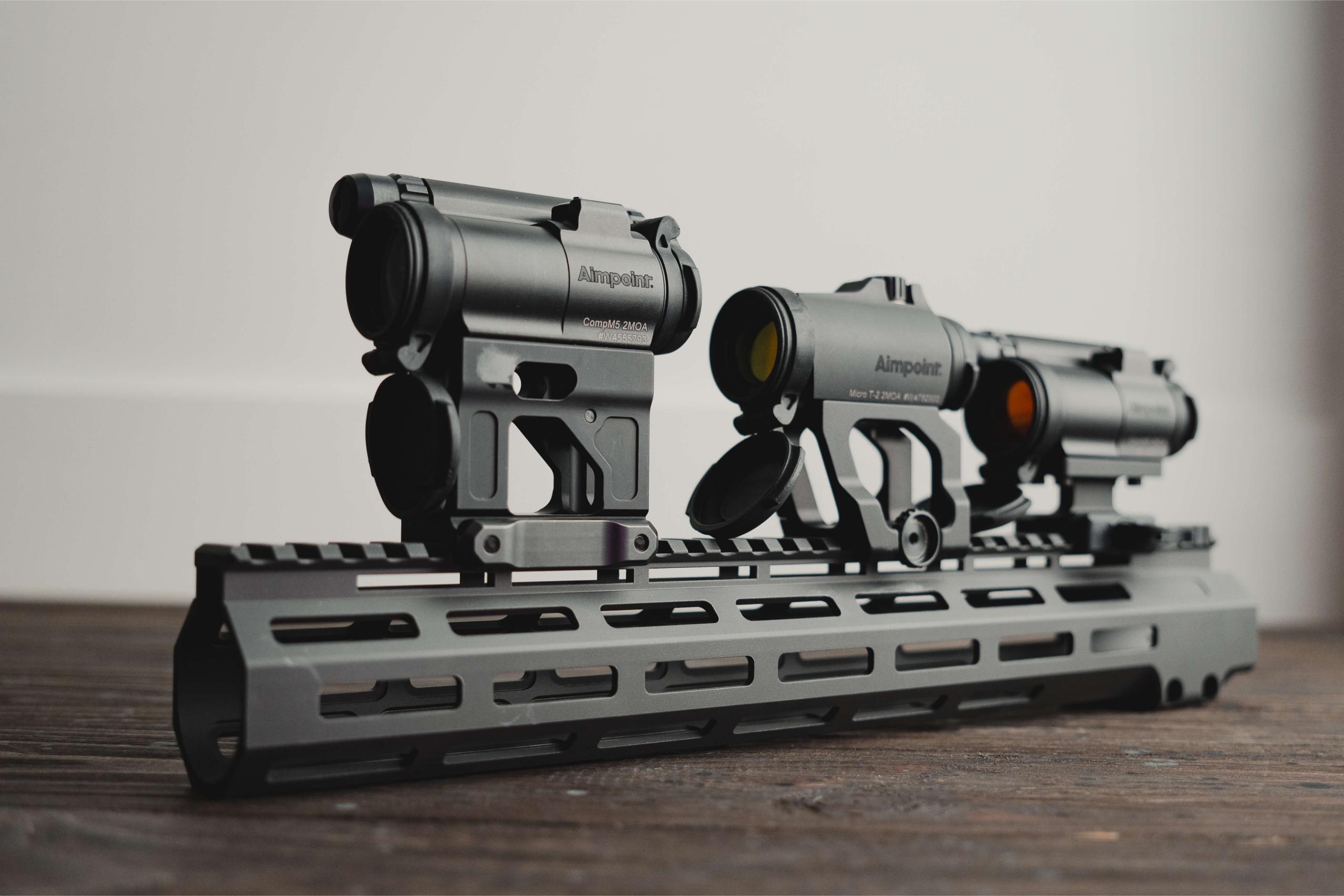
I want to preface this blog post with the fact like most people from my generation we started shooting rifles with absolute co-witness sights and the next evolution was the lower 1/3 which was prevalent with the Eotech.
Like most who are constantly chasing an evolution to my skillset as new gear became available I would jump on the opportunity to try something new. What has become very evident is optic mounts have increasingly become taller.
Optic Heights:
1.42” – Absolute
1.70” – Lower 1/3
1.93” – Scalarworks
2.26” – Unity
From my understanding the higher mounts were developed for the end user shooting behind a gas mask and passive aiming under night vision. As these mounts grew in popularity a few benefits were discovered for the everyday shooter.
The following is taken from the Redback One Article from 2015. He talks about the benefits of the tall optic.
Mitigation of muscular fatigue: The neck. Having a low mounted optic on the rifle forces the shooter to extend the head forward and down in order to acquire the sight picture. This places excessive stress on the trapezius and sternoclidomastoid muscles as they run through the upper part of the neck. Mounting the sight on a high riser block alleviates this stress by keeping the head in a more neutral position and allows the shooter to conduct long clearances more comfortably.
Mitigating muscular fatigue. The eye. By placing the optic low on the rifle and angling the head forward places a high amount of stress on the superior rectus muscle of the eye. This is an extraocular muscle that is innovated by the oculomotor nerve. The superior rectus primary function is elevation and is in its primary position while looking straight ahead. By mounting the combat optic on a high riser block, the shooter can maintain the superior rectus in as close to its neutral position as possible. This not only minimizes stress and fatigue of the eye but also allows the eye to maintain a greater range of motion, which is vital to proper scanning procedures during room combat.
Rearward Mounting and Butt-stock Position: Mounting the sight as far to the rear as possible allows the shooter to maximize the field of view provided by the combat optic. As the Aimpoint Micro is a technically more difficult sight to use due to the restricted field of view compared to other sights on the market, it requires the shooter to be more consistent with rifle presentations and mounting procedures. In order to achieve a more ‘head up’ shooting position the butt-stock must be collapsed to ensure that eye relief can be maintained and mounting speed can be maximized.
Faster Sight Acquisition and Shots on Target: Placing the combat optic on a high riser block means that the shooter has a shorter distance to move the weapon and achieve the mounted shooting position than when setting the sight on a lower mount. Traveling a shorter distance during presentation translates into faster sight acquisition, and also means faster rounds on target.
Night Vision Operations: When employing night vision goggles there will likely be times when the shooter will need to use either the day combat optic with the naked eye or passively sight the rifle by using the NVG behind the combat optic. Two occasions that might occur are when or if the aiming laser fails, or when operating in an environment where there is a belief that the enemy possesses a night fighting capability. In order to achieve either method of targeting while wearing NVG’s, the shooters head must remain in a neutral and upright position.
Gas Mask Operations: In order to be able to quickly mount and target the rifle while using the protective gas mask, the combat optic must be raised to ensure that the weapon is presented naturally and not canted to one side. Having the combat optic mounted low on the rail makes it extremely difficult to sight the weapon making target engagements slower and potentially less accurate. This also places the head in an unnatural position while shooting which is again counter productive to this technique.
I can say for me personally the rifle feels more comfortable with the higher optics allowing a “heads up” approach to shooting and seems to increase my peripheral vision because I’m not hunched down on the rifle with the only real noticeable hinderance being when shooting in prone.
Fast forward a few years of training with the 1.93 or 2.26 height optic mounts, static range shooting, CQB, and a bunch of courses. It appeared I was in a closed loop training regiment with like minded people with similar approaches to training and gear.
This all changed when I attended a rifle course with Matt Pranka from X Ray Alpha Inc. You can search his background and credibility. Minutes into the class I noticed he had what appeared to be a lower mount and when I asked him he confirmed. Fast forward to a drill that forever changed my approach, shooting doubles at 40 yards for time trying to keep the hits in the A-Zone. Without going too far down the rabbit hole after some diagnosis and talking with Matt I decided to ditch my riser and run my optic directly to the receiver (Lower 1/3) right away so I would be able to compare my shooting experience immediately.
After a few reps and runs at the drill my accuracy began to improve with the additional point of contact I was able to apply with my chin/face which provided me with more stability for those follow up shots. For me, I didn’t need the internet to tell me anything, I experienced the difference first hand. This caused me to chase my memories on all the training I had done and I realized I wasn’t shooting at this distance at this for as long as I could remember. Needless to say I would strongly recommend attending one of his classes.
With that said I haven’t ditched all my high mounts as they still provide benefits especially when shooting under night vision.
We sometimes chase fads and trends in gear and convince ourselves we need these things based on what we read on the internet. The only true test of what works for you is to shoot.
So get out there, take some classes with as many different instructors you can find and formulate your own opinion.
As much as I’m sure you’d love to tell you more about optic height, I’m afraid I’m running late to pick up someone’s mom.